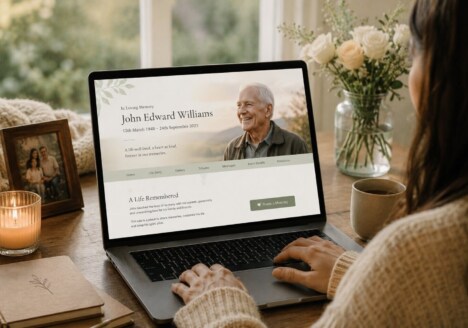

A remembrance website may be visited by grandparents, grandchildren, lifelong friends and people discovering a family story for the first time. Each visitor brings different needs and levels of confidence online. Thoughtful memorial web design can welcome them all, creating a calm place where memories are easy to find, understand and share.
The aim is not simply to place photographs and text on a page. A successful tribute helps people feel connected to the individual through stories, images and carefully chosen details. Families considering this approach can explore the lasting benefits in our guide to why a memorial website is a lasting way to honour a loved one.
Keep Navigation Clear and Familiar
Visitors should never have to work hard to understand where to go. A simple menu with clear labels such as Life Story, Photographs and Tributes makes the website approachable for people of every age. Important content should remain only a few clicks away, whether someone is browsing on a large computer screen or a mobile phone.
Consistency also builds confidence. When headings, buttons and links behave in the same way throughout the site, visitors can focus on remembrance rather than learning how the website works. Generous spacing and comfortable text sizes make longer stories easier to read.
Explain the People and Places in Photographs
A photograph that feels instantly familiar to one generation may be a mystery to the next. Captions can preserve names, relationships, locations and occasions, turning an image gallery into a meaningful record. Even a short sentence can provide the context that keeps a photograph connected to its story.
This careful organisation supports the wider work of preserving family history with a website. Younger relatives can understand how people are connected, while older family members gain a place to record knowledge that might otherwise remain only in conversation.
Offer More Than One Way to Remember
People connect with memories differently. Some prefer to read a detailed biography, while others respond most strongly to photographs, music, short anecdotes or spoken recollections. A well-planned memorial website can include several formats without feeling crowded, giving each visitor a natural way into the story.
Short sections and clear headings help visitors choose how deeply they want to explore. A concise overview can sit alongside longer chapters, galleries and personal messages. This layered approach respects both the visitor who has only a few minutes and the relative who wants to spend time reflecting.
Invite Contributions With Gentle Guidance
Different generations often hold different parts of a life story. Inviting relatives, friends and colleagues to contribute can uncover memories the immediate family has never heard. Simple prompts can help, asking about a favourite quality, a shared adventure or an everyday moment that still brings a smile.
A dedicated website where people can leave tributes can gather these voices in one respectful place. Moderation allows the family to review contributions, maintaining a warm and reassuring environment for everyone who visits.
Design for Accessibility and Comfort
Accessibility is a form of consideration. Strong colour contrast, readable type, descriptive image text and straightforward controls make a remembrance website usable by more people. Pages should adapt cleanly to phones and tablets, and interactive elements should be large enough to use without difficulty.
When every generation can participate comfortably, the memorial becomes a genuine shared space. Older relatives can pass on knowledge, younger family members can explore their heritage, and distant friends can add their own stories. Sensitive remembrance website design helps those memories move between people while keeping the individual at the heart of every page.